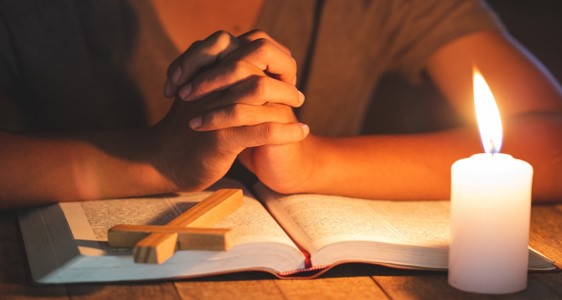
As we’ve been focusing on prayer this Lent, I wanted to share a bit about the central prayer of our Mass, the Eucharistic Prayer.
The Eucharistic Prayer is the part of the Mass that begins after the Altar is set and the priest says, “The Lord be with you … lift up your hearts … let us give thanks to the Lord Our God …”
Then the priest prays the Preface which leads into us singing “Holy, Holy, Holy.” Then, the priest continues with the part of the Eucharist Prayer called Epiclesis — the priest extends his hands over the gifts, asking God the Father to pour out the Holy Spirit upon the gifts; and then, the Consecration — the words of Christ at the Last Supper, “Take this, all of you and eat of it … drink of it …” The Consecration is the climactic moment of the entire Mass; in that moment, the bread and wine become the Sacred Body and Precious Blood of Our Lord and Savior Jesus Christ. It’s when the bread and wine become the Eucharist!
The Eucharistic Prayer then continues with the Memorial where, as we remember Christ’s Death and Resurrection, we offer Christ’s very Sacrifice back to the Lord with humble thanks. Then, includes the Intercessions, praying for others during this Sacrifice: especially the Pope, the Bishop, and all those who have died. The Eucharistic Prayer concludes with a word of praise to the Holy Trinity, called the Doxology. When the priest says, “Through Him, and with Him and in Him …” and the people all acclaim: Amen.
You might not have noticed that there are different Eucharistic Prayers. They all have the same core elements (The Preface, Epiclesis, Consecration, Memorial, Intercessions and Doxology), there are four main Eucharistic Prayers, which are the ones ordinarily and most used.
There are also two other sets of Eucharistic Prayers used on special occasions: 1) The Eucharistic Prayers for Reconciliation, and 2) The Eucharistic Prayers for Various Needs.
For Sundays in Lent, we have been using the Eucharistic Prayers for Reconciliation (the first option), which emphasizes Christ’s work of Reconciling us God the Father (and so too each other).
Speaking of Christ’s work of Reconciliation, attending the Sacrament of Reconciliation is something that is encouraged during Lent as a way of preparing for the great celebration of Holy Week and Easter. A reminder that we will be having times of Communal Reconciliation coming up in the next two weeks, where I and some other priests will be available for confessions.
They will be:
Wednesday, March 18 – 6:30 p.m. at St. Patrick’s, Hampton
Wednesday, March 25 – 4:30p.m. – 5:30pm at St. Mary’s, Ackley
Please join us if you are able.
Other options include:
Sun. March 15 – 2:30pm at Holy Family in Mason City
Sun. March 22 – 3:00pm – St. Mark’s at Iowa Falls
Peace,
— Fr. Kevin
15 de marzo – Plegaria Eucarística de Reconciliación
Ya que durante esta Cuaresma nos hemos centrado en la oración, quería compartir un poco sobre la oración central de nuestra Misa, la Plegaria Eucarística.
La Plegaria Eucarística es la parte de la Misa que comienza después de prepararse el Altar y el sacerdote dice: “El señor esté con ustedes … levantemos el corazón … demos gracias al Señor, nuestro Dios …”
Luego el sacerdote dice el Prefacio que nos lleva a cantar “Santo, Santo, Santo, Santo”. Continúa, después, con la parte de la Plegaria Eucarística, llamada Epíclesis — el sacerdote extiende sus manos sobre las ofrendas, pidiendo a Dios Padre que derrame el Espíritu Santo sobre ellas; y luego, la Consagración — las palabras de Cristo en la Última Cena, “Tomen, coman, beban; esto es mi cuerpo; éste es el cáliz de mi Sangre …” La Consagración es el momento cumbre de toda la Misa; ya que en ese instante el pan y el vino dejan de serlo, y se convierten en el Sagrado Cuerpo y la Preciosísima Sangre de Nuestro Señor y Salvador Jesucristo. ¡Es cuando el pan y el vino se convierten en la Eucaristía!
La Plegaria Eucarística luego continúa con la Oblación donde, al recordar la Muerte y Resurrección de Cristo, ofrecemos el mismo Sacrificio de Cristo al Señor con humilde agradecimiento. Le sigue las Intercesiones, orando por los demás durante este Sacrificio, especialmente por el Papa, el Obispo y todos los que han fallecido. Luego, la Plegaria Eucarística concluye con una palabra de alabanza a la Santísima Trinidad, que se llama Doxología. Cuando el sacerdote dice: “Por Él, con Él y en Él …” confirma con la aclamación del pueblo: Amén.
Quizás no hayas notado que existen diferentes Plegarias Eucarísticas. Aunque todas tienen los mismos elementos principales (Prefacio, Epíclesis, Consagración, Oblación, Intercesiones y Doxología), hay cuatro opciones diferentes, que son las más utilizadas y ordinarias.
También, hay otros dos conjuntos de Plegarias Eucarísticas que se utilizan en ocasiones especiales: 1) Las Plegarias Eucarísticas de Reconciliación, y 2) Las Plegarias Eucarísticas para Varias Necesidades.
Durante los domingos de Cuaresma hemos utilizado las Plegarias Eucarísticas de Reconciliación (la primera opción), que enfatiza la obra de Cristo de reconciliarnos con Dios Padre (y también entre nosotros).
Hablando de la obra de Reconciliación de Cristo, asistir al Sacramento de la Penitencia es algo que se fomenta durante la Cuaresma como una forma de preparación para la gran celebración de la Semana Santa y la Pascua. Un recordatorio de que tendremos momentos de Penitencia Comunitaria en las próximas dos semanas, donde yo y otros sacerdotes estaremos disponibles para confesiones.
Serán:
Miércoles 18 de marzo – 6:30 p.m. en St. Patrick’s, Hampton
Miércoles 25 de marzo – 4:30 p.m. – 5:30pm en St. Mary’s, Ackley
Por favor, únete si puedes.
Otros Opciones
Domingo 15 de marzo – 2:30 p.m. en Holy Family, Mason City
Domingo 22 de marzo – 3:00 p.m. en St. Mark’s, Iowa Falls
Paz
— Padre Kevin