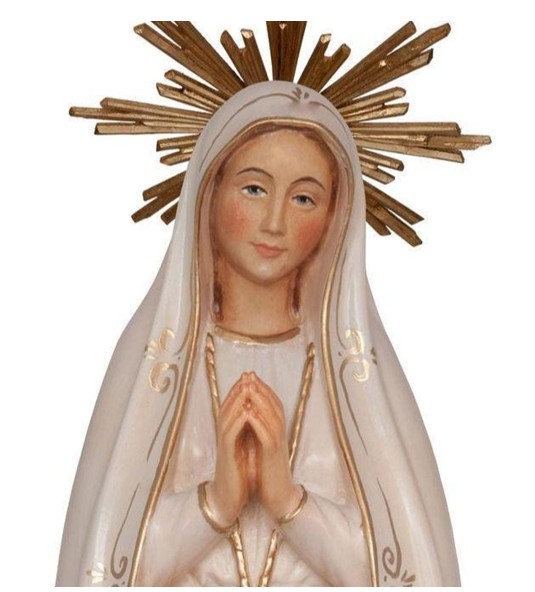
Continuing on the theme of May as the month of Mary, I will share here about Mary’s apparition at Fatima, especially the miracle of the sun at Fatima, Portugal in October of 1917. May 13 is the Feast of Our Lady of Fatima, where we commemorate the apparitions of the Blessed Virgin Mary at Fatima, Portugal in 1917. She appeared six times from May through October, while nations were entangled in the First World War and the atheistic communist revolution was happening in Russia. She appeared to inspire faith in God, conversion to Christ, and to encourage people to pray for peace in the world. As Mary appeared each month to the three children, she promised them she would show them a “sign” during her final apparition in October that others may come to believe. Some people believed the children, many were skeptical, but enough people were intrigued by the children’s promise of a miracle that on October 13, 1917 around 70,000 people gathered with the children, to see if their claims of a miraculous sign would prove true. Catholics and atheists, freethinkers and Jews, communists and secularists, all converged to see this purported miracle.
It was a rainy day, and the field where the people gathered was full of mud. Then, right around noon, the rainy sky cleared up, the clouds dispersed and the ground, which had been wet and muddy from the rain, was dried (seemingly in but a few moments). A transparent veil came over the sun, making it easy to look at, and multi-colored lights were strewn across the landscape. The sun then began to spin, twirling in the sky, and at one point appeared to veer toward earth before jumping back to its place in the sky.
People gasped and cried out. Many fell to their knees and began to pray. Some cried out that it was the end of the world. Faithful believers and non-believers alike claimed to see the seemingly miraculous movements of the sun. The stunning miracle was a direct, and very convincing contradiction to the atheistic regimes at the time, which is evidenced by the fact that the first newspaper to report on the miracle on a full front page was an anti-Catholic, Masonic newspaper. The chief editor of this newspaper, Avelino de Almeida was himself present at the event and himself said he that, “outside of all cosmic laws, ‘the sun danced.’”
Duarte, a theologian and director of the Fatima shrine museums, spoke about the cultural significance of the Miracle of the Sun given the atheistic thought prevalent in Portuguese society at the time. The Miracle of the Sun, was understood by the people to be “the seal, the guarantee that in fact those three children were telling the truth.” He says that even today, “Fatima makes people change their perception of God,” since “one of the most important messages of the apparitions is that even if man has separated God from his existence, God is present in human history and doesn’t abandon humanity.”
Peace,
-Fr. Kevin
31 de mayo – Nuestra Virgen de Fatima y El Milagro del Sol – Fátima, Portugal, 1917
Continuando con la tema de mayo come el mes de la Virgen Maria quiero hablar hoy del Milagro del Sol en Fátima, Portugal en octubre de 1917.
El 13 de mayo es la Fiesta de Nuestra Señora de Fátima, cuando conmemoramos las apariciones de nuestra Santísima Virgen María en Fátima, Portugal en 1917. Apareció seis veces desde mayo hasta octubre, mientras las naciones estaban enredadas en la Primera Guerra Mundial y la revolución comunista atea ocurría en Rusia. Apareció para inspirar fe en Dios, conversión a Cristo y animar a las personas a orar por la paz del mundo.
María prometió a los tres niños que durante su última aparición, en Octubre, mostraría una “señal” que convertiría a muchos. Algunos le creyeron a los niños, muchos se mostraron escépticos, pero suficientes personas estaban intrigadas por la promesa de los niños de un milagro que el 13 de octubre de 1917, alrededor de 70.000 personas se reunieron con los niños para ver si
las afirmaciones de una señal milagrosa resultarían ciertas. Católicos y ateos, librepensadores y judíos, comunistas y secularistas, todos se congregaron para presenciar este supuesto milagro.
Era un día lluvioso, y el terreno donde se reunía la gente estaba lleno de lodo. Luego, justo alrededor del mediodía, el cielo despejó, las nubes se dispersaron y el terreno, que estaba mojado y barroso con la lluvia, se secó (aparentemente en pocos momentos). Un velo transparente cubrió
el sol, haciéndolo fácil de observar, y luces multicolores se esparcieron por el paisaje. Luego, el sol comenzó a girar; dando vueltas en el cielo, y en un momento pareció caer a la tierra antes de volver a tomar su lugar en el cielo.
Personas gemían y lloraban. Muchos se arrodillaron y comenzaron a orar. Algunos clamaban que era el fin del mundo. Fieles creyentes y no creyentes afirmaban haber visto los movimientos milagrosos del sol. El sorprendente milagro fue una contradicción directa y muy convincente con los regímenes ateos de la época, lo que se evidencia por el hecho de que el primer periódico que informó sobre el milagro en portada completa fue uno masónico anticatólico. El periodista del diario Avelino de Almeida estuvo presente y dijo, “fuera de cualquier ley cósmica, ‘el sol bailó’”.
Duarte, teólogo y director de los museos del santuario de Fátima, habló sobre el significado cultural del Milagro del Sol dado el pensamiento ateo prevaleciente en la sociedad portuguesa de la época. El Milagro del Sol fue entendido por la gente como “el sello, la garantía de que en realidad esos tres niños estaban diciendo la verdad”. Dice que incluso hoy en día, “Fátima hace
que la gente cambie su percepción de Dios”, ya que “uno de los mensajes más importantes de las apariciones es que aunque el hombre haya separado a Dios de su existencia, Dios está presente en la historia humana y no abandona a la humanidad”.
Paz,
– Padre Kevin